Your Ad Here
Your Ad Here
Showing posts with label Economy Facts. Show all posts

Wednesday, November 24, 2010

Karadeniz Power Ship for Pakistan

SOS for Pakistan – The KAYABEY Power Ship

Pakistan is facing the worst ever electricity crisis in its history. Thanks to years of mismanagement, shortsightedness and corruption; a country bestowed with rivers, enough wind to generate 50,000 MW and a Solar belt that can also generate an additional thousands of Mega Watts of electricity, not to mention the world’s biggest coal reserves. The city of Karachi, the industrial hub of Pakistan and a city which generates almost 65 % of the country’s revenue was the worst hit. Karachiites suffered, and are still experiencing up to 12 hours of load shedding. Now a Turkish Power Ship, perhaps the only of its kind has set sail from Istanbul to Karachi which will give the city a relief of some 230 MW. This agreement has been signed for a period of 60 months, or 5 years. This may sound as good news, but the point to note here is that this is again a short term solution, it will run on fossil fuel and it is not going to be cheap, not at all.

Our daily newspapers carried this story along with a photograph of the ship which words like “ To end the power problems of Pakistani brothers and sisters”. Well, I have no qualms at admitting that I wept on seeing this picture. Not because it carried an emotional message, but because despite being bestowed with so much we are still waiting for God knows who to help us and alleviate our problems. That perhaps is the most painful thing. The leadership will never understand this, there are suffering from acute shortsightedness I guess.

Sunday, September 27, 2009

Doomsayers beware: Japan's top foreign-exchange official said dollar will stay as reserve currency for next 20 years.

Eisuke Sakakibara, formerly Japan’s top foreign-exchange official, said the dollar will stay the main reserve currency after a United Nations report this week said the greenback’s role in global trade should be reduced.

“The U.S. will remain as the world leader for at least a few more decades,” Sakakibara, the Democratic Party of Japan’s top choice in 2003 to lead the Finance Ministry, said today in an event hosted by the Japan National Press Club in Tokyo. “The dollar will stay the reserve currency for the next 20 years.”

The comment by Sakakibara, known as “Mr. Yen” from his 1997-1999 tenure at the Ministry of Finance, comes after a UN report published Sept. 7 said a new currency should be created to reduce the dollar’s role and protect emerging markets from the “confidence game” of financial speculation. China, India, Brazil and Russia this year called for a replacement to the dollar as the main reserve currency after the financial crisis led to the worst global recession since World War II.

Prime Minister-designate Yukio Hatoyama’s Democratic Party of Japan has no plan to diversify the country’s foreign reserves away from the dollar, party Secretary-General Katsuya Okada said on July 24. Japan, the biggest international owner of U.S. government debt after China, raised its total holdings of Treasuries by $34.6 billion to $711.8 billion in June.

Sakakibara said the DPJ hasn’t approached him to take a role in Japan’s new government. Japan should sell an extra 10 trillion yen ($108.1 billion) in government bonds to pay for economic stimulus measures, Sakakibara said. Ten-year yields, now at 1.325 percent, will stay below 2 percent even if debt sales increase, he said.

“The market has plenty room to take in that amount of bonds,” Sakakibara said. More issuance is “the only choice the government has to fund new measures and deal with falling revenues,” he said. Japan’s debt burden will probably spiral to 197 percent of gross domestic product next year, according to the Organization for Economic Cooperation and Development. The Finance Ministry in April said it will boost bond issuance by 15 percent to 130.2 trillion yen this fiscal year.

Sakakibara also said a single regional currency for Asia won’t become a reality until China deregulates its currency. “China is unlikely to remove regulations on its currency for at least 10 years,” Sakakibara said. “The common Asian currency won’t be created until that happens.” Japan should work with other Asian nations to create a single regional currency, the DPJ’s Hatoyama wrote in the New York Times last month. "

Sunday, September 13, 2009

How to Get Out of Debt and Get Rich

With the right attitude and a little credit know-how, anyone can climb out of the hole and stay debt-free for life

"My name is John, and I'm a recovered compulsive debtor."

John and thousands like him meet across America -- in church basements and high school auditoriums -- every week. They talk about blowing the mortgage payment on gourmet restaurant meals, then scrounging to find enough coins for the tollbooth. They know that sick dread while opening the mailbox, wondering which bill is now due. They've seen how debt can destroy marriages and even lead to suicide.

They're members of Debtors Anonymous, a 12-step program modeled on Alcoholics Anonymous. They are clerks and executives, artists and electricians. Some have trust funds, others make minimum wage. Some overcharged on credit cards, others bought "fully-loaded" cars with seven-year loans, still others moved into lavish homes with interest-only mortgages. What they have in common is an overwhelming temptation to spend more than they earn. If you think that makes them different from the rest of us, consider this:
Americans bought over $2 trillion worth of stuff on credit last year.

Current outstanding debt on credit cards -- that's the "revolving" part that we don't pay off every month -- totals nearly $700 billion, up from just $50 billion in 1980.

Three of five American families can't pay off their credit cards each month. Their running balance averages about $12,000, which is one-fourth of the median household income.

By the mid-1990s, credit card debt held by Americans living below the poverty level more than doubled.

Senior citizens, once noted for their frugality, are sinking deeper into debt: Their average credit card balance increased by 89 percent between 1992 and 2001.

Total consumer debt in the United States comes to over $7,100 per person -- and that doesn't include mortgages.

Grim as that sounds, there's help to be had. With the right attitude and a little credit know-how, anyone can climb out of the hole and stay debt-free for life.

Just ask Wayne and Rebecca Denton of Clayton, North Carolina. In the 1990s, while Rebecca was in nursing school, Wayne, a lawn-care technician, began putting all their purchases on eight credit cards. By 1998 they were $88,000 in debt -- more than their combined annual income of $61,000.

At first Wayne tried to hide the debt from Rebecca. But it got so bad that he couldn't even make the late-payment penalties, much less pay the bills. Eventually the phone was shut off, and Wayne had to borrow money from relatives just to buy food. The couple hit bottom when Rebecca considered filing separation papers. "But the lawyer told me that we'd be fighting over assumption of debt," she recalls. "I was shocked. In most divorces, people fight over assets. We had no assets."

Rebecca says she "cried to God to save my marriage." The turning point came when she bought a $12.95 workbook by radio host and debt-reduction guru Dave Ramsey. The couple cut up their credit cards, and started working overtime to pay the bills. "Instead of getting mad at each other, we got mad at the debt," says Rebecca.

Seven years later, with one son and another on the way, the Dentons are debt-free, living in a larger house and building up their savings. "It's been a radical change in our thought process," says Rebecca, "but I wouldn't trade it for anything." They keep one credit card for buying gas, which they pay off every month. And they read the fine print. "The credit card companies are really trying to put one past you," says Rebecca.

It wasn't always that way. Back in the 1950s, banks introduced credit cards to promote customer loyalty, especially the kind of customer who would pay the bill in full each month. The business grew steadily but remained fairly genteel until the 1980s, when a series of state and federal deregulations made it possible for banks to charge more interest and operate nationally. Nationwide marketing opened the floodgates. In 2003, banks mailed out 5.2 billion offers for credit cards.

Today more than 75 percent of American families have at least one credit card, which makes it possible to rent cars, shop on the Internet, and buy plane tickets. "You need a credit card," says Terry Savage, the syndicated Chicago Sun-Times financial columnist.

What you don't need, she adds, is the long-term debt. Banks make more interest when people pay over time; that's why minimum payments on credit cards have shrunk to as low as one percent of the total balance. With payments that small, it sounds so easy.

But wait: The average college student owes almost $2,800 on plastic, and that doesn't include student loans. If she pays $50 a month, assuming an 18 percent interest rate, it will take her more than ten years to pay off the credit card -- at a total cost of $6,154.

Financial experts agree that personal responsibility could prevent most debt problems; don't spend it, and you won't have to pay it back. But they still put some of the blame on banks, which lure new customers with low rates, then jack up the interest if they're late on just one payment. Many consumers are unaware that banks can raise your rate if you're late paying a completely unrelated bill, such as your mortgage. (It's in the fine print.)

Banks argue that late payments indicate credit risk, justifying higher rates. But in recent years banks have redefined what's risky -- often raising rates and charging penalties if a payment is late by even a few minutes. According to Robert Manning, a noted industry expert, late fees rose from $1.7 billion in 1996 to $7.7 billion in 2003.

Officials at the American Bankers Association, the trade group representing the credit card industry, say this: "Lenders use penalty fees as a risk-management tool against customers who mishandle their finances."

Dave Ramsey has seen it all: "When you hear about a 78-year-old widow living on $800 a month in Social Security, and the credit card company lets her rack up $70,000 in debt, there's a lot of corporate immorality there."

How much debt is okay? Savage recommends that your mortgage payment plus property tax and home insurance total no more than 40 percent of your take-home pay; Ramsey says no more than 25 percent. If you haven't already consolidated your student loans, do so before June 30: "Consolidation rates are the lowest ever," she says, "and if you agree to have the payment automatically withdrawn from your checking account, they'll usually knock another quarter point off the rate." Car loans -- up to four or five years at a low interest rate -- are also acceptable. "If you need a seven-year car loan, you're buying too much car," says Savage.

Total debt, though, should never be more than half your take-home pay -- and that's assuming you're putting the maximum into a 401(k) before taxes.

As for credit card debt, most experts agree that any is too much. "If you can only make the minimum payment on your credit cards," says Savage, "that's when you know that debt has become your lifestyle."

Struggling to keep up with those payments, nearly 9 million Americans seek debt counseling every year. Sadly, many will wind up deeper in debt -- victims of overpriced schemes that promise to "Pay Down Your Debt!"

According to a 2003 study by the National Consumer Law Center and the Consumer Federation of America, many debt counselors are little more than telephone solicitors, raking in high-pressure "donations" from debtors -- as much as $50 a month plus a sign-up fee that can total a month's worth of debt -- in return for making payments and negotiating lower late fees and interest rates with banks.

But consumers can often get just as good a deal by calling creditors themselves. Furthermore, the plans almost never address secured debt like mortgages and car payments. That means a serious debtor could still lose his home or car, even if the credit card bills are paid -- not much of a deal.

Five years ago, Dolores and Aldo Porziella of Hyde Park, Massachusetts, were in debt "up to our eyeballs" -- owing $10,000 on credit cards while getting by on Aldo's modest income as a hairdresser. The Porziellas signed on for a debt-management plan with Florida-based Consolidated Credit Counseling Services.

For a fee of about $30 a month, Consolidated offered to negotiate lower interest rates on three Porziella credit accounts. But Dolores was looking for even lower rates, and after just one payment, decided to take her business elsewhere. "They may say they're nonprofit," says Dolores, "but I don't think they're in business to help you out."

Technically speaking, Consolidated is not "in business" at all; it's a tax-exempt charity. In 2003 the organization reported revenues of nearly $23 million. Some of that revenue was paid to for-profit companies with ties to officers of Consolidated, for bill processing and other operations. Consolidated spokeswoman April Lewis-Parks notes that the company pays under fair-market value for such work. Lewis-Parks also says that the Porziellas dropped out of the program too soon to see results, and withheld information about some of their creditors. "We have over 50,000 clients, and we strive to provide each person with exemplary service."

For just $9 a month, the Porziellas switched to Consumer Credit Counseling Service of Southern New England, part of a counseling network endorsed by Terry Savage and other experts. CCCS got the couple's Visa card rate lowered from 20 percent to 6 percent. In December the couple made their last payment on that card.

Living debt-free is about more than getting creditors off your back. Knowing you have the financial leeway to weather hardships brings priceless peace of mind to Gary and Sue Cowan. When Tropical Storm Allison hit Houston in June 2001, the Cowans' home was flooded. "We had to leave our house by boat," recalls Sue, who was five months pregnant with her third child. But with their credit cards maxed out at $50,000 and no savings, they couldn't afford the repairs that insurance didn't cover. Six months later, Gary was laid off from his $60,000 technology job. "We were devastated," says Sue. The couple declared bankruptcy.

Soon, though, fresh credit card offers began arriving in the mail. "Bankruptcy doesn't mean anything to them," says Sue. "They just jack up the interest rates." With Gary scraping by on a series of short-term jobs and Sue working at a grocery store, the Cowans quickly rang up $30,000 in new debt.

Sue admits she was a shopaholic: "I wouldn't buy my kids' clothes at Target," she recalls. "I shopped at Dillard's" -- an upscale department store. The Cowans finally changed their habits, selling off the house to pay debts and committing to living within their means. "There's a mentality in this country that if you can afford the payment, you can afford the thing," says Sue. "Now our attitude is if we don't have the cash, we don't buy it." It's a way of life they're trying to pass on to their kids. "Our 11-year-old has $1,000 in savings, and she even made a donation to an orphanage," says Sue with pride.

Leading by example could be the best hope for a debt-free future. "Right now we're teaching our kids how to be great consumers," says Dallas Salisbury, chairman of the American Savings Education Council. "Spending is like binge drinking, and the comedown can be very harsh. Moving away from the consumption message will take a personality transplant for the nation."

Thursday, September 10, 2009

Cash for Clunkers: How Big an Environmental Boost?

Not even the most optimistic greens could have predicted that the federal government's cash-for-clunkers program would work this well — more than 240,000 Americans have traded in their clunkers so far, and the program has already burned through its first round of funding. But green groups were a bit wary of cash for clunkers at the outset, concerned that the legislation's requirements on fuel economy were too lax. Under the program, newly purchased passenger cars must have a minimum fuel-economy rating of 22 miles per gallon — hardly superefficient — and they need to be only 4 m.p.g. more efficient than the clunker being traded in to trigger the $3,500 credit. (The $4,500 credit requires an improvement in fuel economy of at least 10 m.p.g.) And there's the undeniable fact that destroying an existing car — even a clunker — and manufacturing a new one requires energy and carbon emissions that would be saved if you just held onto your old car.

The initial data released by Department of Transportation, however, shows that so far cash for clunkers has been a green success. The clunkers averaged 15.8 m.p.g., compared with 25.4 m.p.g. for the new vehicles purchased, for an average fuel-economy increase of 61%. On the whole, American drivers are trading in inefficient trucks and SUVs for much more efficient passenger cars. Car manufacturers like Nissan are already retooling some models to improve their fuel economy so they can qualify for the credits. The early numbers were enough to convince California Senator Dianne Feinstein to go from criticizing cash for clunkers as too lax to supporting additional funding for the bill in the Senate. "This program has done much better than we ever thought it would for the environment," she told reporters on Aug. 4.

But while cash for clunkers has helped out the U.S. auto industry and the environment — two entities that have clearly seen better days — it shouldn't obscure the need for addressing the real green cost of driving: gas prices. It's not the car or truck that adds greenhouse-gas emissions into the atmosphere — it's burning gasoline. There's no denying that it's beneficial for Americans to climb out of their clunkers and into more efficient cars, but what happens if drivers take advantage of the lowered cost of their fuel bill by driving more? The environmental benefits of cash for clunkers goes up in smoke.

It's called the efficiency paradox: as we get more efficient at using energy — through less wasteful cars and appliances — the overall cost of energy goes down, but we respond by using more of it. In the case of cars, that means driving more. Ultimately our gas bill stays the same, but we spend more time on the road and pump the same amount of greenhouse-gas emissions into the atmosphere. The earth isn't any better off.

To address the emissions problem directly, we need to look at fuel, not Fords: institute carbon taxes that raise the price of gas. We already know that higher gas prices discourage driving and reduce greenhouse-gas emissions — total vehicle miles traveled in the U.S. declined 3.6% in 2008 compared with the previous year, thanks largely to the sky-high price of gas for much of 2008. (The recession didn't help, but sharp declines in driving began well before the bottom dropped out of the economy.) As gas prices have fallen in 2009, however, driving has begun to tick back up.

Americans already pay considerably less than the Europeans and Japanese for gas — it's one of the reasons we've been able to subsidize a wasteful SUV lifestyle for so long. A smart tax would stabilize the price of gas at a high enough level to discourage driving — and it would generate revenue that could be used for a number of green programs, including cash for clunkers. Certainly, efficiency is an important goal — a new report from McKinsey & Co. found that the U.S. economy could save $1.2 trillion through 2020 by investing $520 billion in various efficiency investments — and encouraging the switch to less wasteful cars is smart policy. But unless we end the era of cheap gas too, those savings will go down the drain.

Tuesday, September 8, 2009

Forget gold. Silver is shining bright.


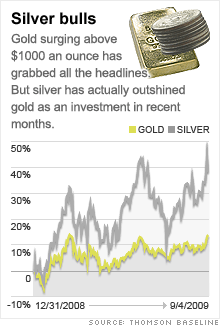
Silver has outperformed the yellow metal in recent months - and the silver spike might have more to do with a global economic recovery than inflation fears.


NEW YORK (CNNMoney.com) -- All that glitters isn't necessarily gold. If you want a really hot metal, check out silver.
Yeah, the price of gold rose above $1,000 an ounceTuesday. And Gold is now up more than 5% in the past month and nearly 15% this year. But silver has done even better as of late.
Silver prices hit a 13-month high of about $16.72 an ounce Tuesday and silver prices are now up about 40% so far this year. Silver doesn't get as much attention for obvious reasons. "Gold above $1,000" is a sexier headline than "Silver surges past $16."
But the spike in silver is worth noting since it might be a sign that a global economic recovery could actually be for real.
Sure, one reason that silver is up is due to inflation fears. That's probably the main reason that gold has skyrocketed.
Some investors are worrying about the impact that government spending will have on the dollar and are subsequently buying gold, other metals and oil -- i.e. tangible assets as opposed to paper currency -- as a safe haven.
The dollar was hovering around a year-to-date low against a basket of global currencies Tuesday. So that helped lead silver and other commodities higher as well.
"Silver, gold and crude oil are all predominantly priced in U.S. dollars. So it's a natural reflex for them to go up in the short-term when the dollar is weak," said John Kicklighter, a currency strategist with CFD Trading, a New York-based research firm owned by foreign exchange broker FXCM.
But while gold has relatively few uses for manufacturers (besides looking pretty for jewelry), silver, much like copper, is a component of a variety of industrial products.
Silver is a component for products ranging from batteries and semiconductors to solar panels and water purification systems. That means that there are more than just inflation concerns driving up the price of silver.
"There is such a high demand for industrial use of silver. So a lot of companies, particularly in Asia, are gobbling it up in order to get their economies growing again," said David Beahm, vice president of economic research with Blanchard & Co., a New Orleans-based investing firm that specializes in gold and other precious metals.
Beahm said that silver's spike is a recovery from the depressed levels of late last year when investors were panicking about the state of the economy in the wake of the collapse of Lehman Brothers. Silver dipped below $9 an ounce last October.
"The real reason silver is going up now is because it took such a beating during the fears of deflation," Beahm said.
In that respect, the surge in silver prices is probably more similar to the rally in other assets that had been priced for financial Armageddon, such as bank stocks and airline stocks.

For the average investor, Beahm said that silver might make more sense to buy than gold since silver is more affordable. That said, he thinks gold will outperform silver over the long run because he believes that inflation and weak dollar fears should persist.
There are other ways to invest in silver without buying the physical metal though. The iShares Silver Trust (SLV) is an exchange-traded fund that is designed to track the price of silver. Several mining companies with a heavy emphasis on silver, including Hecla Mining (HL), Silver Wheaton (SLW) and Silver Standard Resources (SSRI), have piggybacked silver's rise and performed extremely well in recent months.
Still, even for investors reluctant to add precious metals to their portfolio, the price of silver and gold bears watching.
Kicklighter said investors seeking the proverbial silver lining in the economic clouds (Sorry. I couldn't resist) should pay more attention to silver and other metals as a possible proxy for a recovery.
"Longer-term there should be a divergence between gold and other commodities. Gold is going to be more responsive to investor sentiment and risk appetites," he said. "If you're looking for a forecast of global improvement and growth overall, industrial metals like silver are going to move more on demand."

Monday, September 7, 2009

During rising inflation, women are the first to suffer says study

Skyrocketing prices for food and fuel have pushed more than 130 million poor people across parts of Africa, Asia and Latin America deeper into poverty in the past year, and guess who are the "hungriest" and "skinniest" victims? Women. Malnutrition among females is emerging as a "hidden consequence" of the food crisis, reports Kevin Sullivan for the Washington Post. Sullivan's focus is the African nation of Burkina Faso, where he follows the life of a woman named Fanta Lingani, who starts her backbreaking streetsweeping job at 4:30 am and makes $10 a month.

On her way to the market, Lingani explained the ugly math: A year ago, she could feed her entire family a nutritious meal of meat and vegetables and peanut sauce for about 75 cents. But now the family gets much lower-quality food for twice the price … "When the children ask for food, we have to give it to them," she said. "We're mothers."

It's not just an economic problem; it's also cultural. Shopping and cooking, aka making sure the family has food, is "the job of women," Lingani's husband, a retired police officer, says. He has three wives. One, who is nearly blind, can't do chores. Lingani and the other working wife each give part of their salary to their husband, and he gets a bowl of food that is roughly the same size as one that the two wives and eight small grandchildren share. (The food is dried fish and baobab leaves flavored with potash, a paste made by boiling down water strained through ashes.)

A recent study has shown that people in Burkina Faso spend 75% of their income on food. Pregnant women and young mothers sacrifice medical care; some turn to prostitution to pay for food. Families who can't pay for school and school clothes take girls out of school. There's no upside here people, just something to think about when we're complaining about the price of Starbucks or gas