Can I get infected with 2009 H1N1 virus from eating or preparing pork?
No. 2009 H1N1 viruses are not spread by food. You cannot get infected with novel HIN1 virus from eating pork or pork products. Eating properly handled and cooked pork products is safe.
How long can influenza virus remain viable on objects (such as books and doorknobs)?
Studies have shown that influenza virus can survive on environmental surfaces and can infect a person for 2 to 8 hours after being deposited on the surface.
How does 2009 H1N1 virus spread?
Spread of 2009 H1N1 virus is thought to occur in the same way that seasonal flu spreads. Flu viruses are spread mainly from person to person through coughing or sneezing by people with influenza. Sometimes people may become infected by touching something – such as a surface or object – with flu viruses on it and then touching their mouth or nose.
What are the signs and symptoms of this virus in people?
The symptoms of 2009 H1N1 flu virus in people include fever, cough, sore throat, runny or stuffy nose, body aches, headache, chills and fatigue. A significant number of people who have been infected with this virus also have reported diarrhea and vomiting. Severe illnesses and death has occurred as a result of illness associated with this virus.
What surfaces are most likely to be sources of contamination?
Germs can be spread when a person touches something that is contaminated with germs and then touches his or her eyes, nose, or mouth. Droplets from a cough or sneeze of an infected person move through the air. Germs can be spread when a person touches respiratory droplets from another person on a surface like a desk, for example, and then touches their own eyes, mouth or nose before washing their hands.
10 Protect-Yourself Tips
1. CDC recommends a yearly seasonal flu vaccine as the first and most important step in protecting against seasonal influenza.
2. If you get seasonal or novel H1N1 flu, antiviral drugs can treat the flu.
3. For treatment, antiviral drugs work best if started within the first 2 days of symptoms.
4. Cover your nose and mouth with a tissue when you cough or sneeze. Throw the tissue in the trash after you use it.
5. Wash your hands often with soap and water, especially after you cough or sneeze. Alcohol-based hand cleaners are also effective.
6. Avoid touching your eyes, nose or mouth. Germs spread this way.
7. Try to avoid close contact with sick people.
8. If you are sick with flu-like illness, CDC recommends that you stay home for at least 24 hours after your fever is gone except to get medical care or for other necessities. (Your fever should be gone without the use of a fever-reducing medicine.) Keep away from others as much as possible to keep from making others sick.
9. Follow public health advice regarding school closures, avoiding crowds and other social distancing measures.
10. Be prepared in case you get sick and need to stay home for a week or so; a supply of over-the-counter medicines, alcohol-based hand rubs, tissues and other related items might could be useful and help avoid the need to make trips out in public while you are sick and contagious


Showing posts with label Swine Flu Facts. Show all posts
Showing posts with label Swine Flu Facts. Show all posts
Sunday, September 13, 2009


Thursday, September 10, 2009
Herbs For Preventing Swine Flu
Swine flu is fast spreading around the world and WHO has already declared it a pandemic, but this virus is not as deadly as the media has made it out to be. Some simple precautionary measures can easily help you prevent this flu and even if you get this flu your body can fight it out if you have a good immune system
Who is at risk
It has been noted that people who are suffering from any time of health condition like diabetes or who have a weak immune system like children and aged people have been primarily targeted by this virus.
How To Prevent Swine Flu
There are a lot of things which you can do to minimize the chances of catching swine flu, let us lay out some of them.
1. Wash your hands frequently.
2. Take proper sleep as it will help boost your immune system.
3. Drink adequate water to keep your body hydrated.
4. Take steps to improve your immune system you can take the help of ayurvedic herbs like Echinacea which are known to boost the immunity system.
5. Keep away from people who are ill as they may act as carriers of flu.
6. Avoid crowded places as there are more chances of getting flu in such places.
Herbs That Can Immunize Your Body
Although in ayurveda there is no mention of swine flu but symptoms similar to it have been mentioned. It is mentioned that flu is the result of weakening up of body’s defense mechanism so in order to fight flu body has to strengthen its immunity levels. Herbs like neem and ginger are taken to prevent flu and once the body becomes strong then Echinacea and triphala are given to completely eradicate the flu symptoms.
Looking at all the indications it is imperative to give yourself fit so that you can fight the H1N1 virus successfully all you have to do is follow some basic rules of keeping your body clean and healthy and you will probably survive this pandemic.
Who is at risk
It has been noted that people who are suffering from any time of health condition like diabetes or who have a weak immune system like children and aged people have been primarily targeted by this virus.
How To Prevent Swine Flu
There are a lot of things which you can do to minimize the chances of catching swine flu, let us lay out some of them.
1. Wash your hands frequently.
2. Take proper sleep as it will help boost your immune system.
3. Drink adequate water to keep your body hydrated.
4. Take steps to improve your immune system you can take the help of ayurvedic herbs like Echinacea which are known to boost the immunity system.
5. Keep away from people who are ill as they may act as carriers of flu.
6. Avoid crowded places as there are more chances of getting flu in such places.
Herbs That Can Immunize Your Body
Although in ayurveda there is no mention of swine flu but symptoms similar to it have been mentioned. It is mentioned that flu is the result of weakening up of body’s defense mechanism so in order to fight flu body has to strengthen its immunity levels. Herbs like neem and ginger are taken to prevent flu and once the body becomes strong then Echinacea and triphala are given to completely eradicate the flu symptoms.
Looking at all the indications it is imperative to give yourself fit so that you can fight the H1N1 virus successfully all you have to do is follow some basic rules of keeping your body clean and healthy and you will probably survive this pandemic.
Is a Swine Flu Outbreak Coming? Ask Your iPhone
Outbreaks Near Me is a new iPhone app that warns of disease outbreaks in your vicinity. Yep, it'll let you know if swine flu is lurking. It was created by researchers at Children's Hospital Boston and relies on the same reports that health officials use to track disease.
If you're wondering whether the H1N1 flu epidemic has infiltrated your town yet, there's an iPhone app for that. Created by researchers at Children's Hospital Boston, the new app, called Outbreaks Near Me, gives users real-time information about the type and scope of any new disease outbreaks in their area.
The app is based on the same network of media and on-the-ground reporting that global health officials use to detect and track emerging diseases like H1N1 and 2003's SARS. Indeed, the first details of the strange respiratory disease, which surfaced in southern China six years ago, weren't published in a medical journal, nor were they issued by the World Health Organization (WHO). Rather, the earliest hints came in the media, in stories published in Chinese newspapers about people in Guangzhou and Shenzhen being struck down by a mysterious illness. Because Chinese officials forbade official reporting of the new disease, the WHO and the rest of the international health community didn't become fully aware of the situation until the infection — which would later be called Severe Acute Respiratory Syndrome, or SARS — crossed the border to Hong Kong and then to the rest of the world.
If epidemiologists had been able to pick up those early media reports about SARS, the disease might not have gone on to kill nearly 800 people. That's one of the reasons researchers at Children's Hospital Boston, together with the Massachusetts Institute of Technology (MIT) Media Lab, developed HealthMap, a website that mines more than 30,000 data sources — including news media and government alerts — and puts them on a Google Map to show where outbreaks are occurring, in real time. Whether it's measles in Sussex, foot-and-mouth disease in Taiwan or avian flu in Indonesia, as reports of diseases bubble up, HealthMap researchers scan them and post them online. The result is about as close as you can get to a real-time picture of the state of the world's health, and it's become a useful tool for both professional epidemiologists and curious amateurs. "We wanted to bring all this information to life in a way that's accessible to everyone," says John Brownstein, an assistant professor at Children's Hospital Informatics Program (CHIP), who co-founded HealthMap and Outbreaks Near Me.
The iPhone app makes HealthMap information even more accessible to the average person, by marrying the map's network of global data with the smartphone's GPS function, which tracks an individual user's location. So the program enables you to find out instantly whether there are any new outbreaks close to home. "The system can deliver reports that are relevant to your location," says Clark Freifield, a Ph.D. student at MIT's Media Lab and a co-founder of HealthMap.
The Outbreaks app also allows users to do their own surveillance and reporting — you can send messages and images to HealthMap about disease flare-ups in your area. The idea is to further broaden the net of health information beyond official sources. Think how useful a few iPhone-armed people in Mexico might have been during the initial waves of the H1N1 outbreak last spring — or how they might affect the upcoming flu season in the U.S. this autumn. "We're not sure what kind of response we'll see, but the idea is to develop a two-way flow of information," says Freifield.
Certainly, opening HealthMap to user-based reports could introduce an element of chaos, and even outright panic, into disease surveillance — ordinary people aren't trained epidemiologists. Global health officials already struggle to separate the noise from the truth; for every actual outbreak of a new disease, there are countless false or overstated reports. But in an interconnected age, when both information and disease can spread in an instant, having an imperfect network is better than none at all. "This is an alert tool that is not trying to raise fear but awareness instead," says Brownstein. "We want to encourage good public-health information, and at the end of the day that's what this app is about." Knowing too much may be scary, but knowing nothing is far more dangerous.
Tuesday, September 8, 2009
Doctors slash vaccines due to rising costs
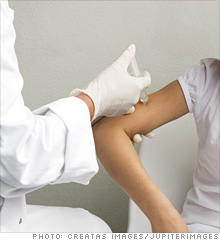
Health care providers say insurers don't reimburse them enough for essential vaccinations, so they're not offering them.
NEW YORK (CNNMoney.com) -- Parents who bring their kids to Dr. G. Andrew McIntosh for the chicken pox vaccine are out of luck.
The family physician, who has a solo practice in Uniontown, Ohio, doesn't offer that shot because he can't afford it. Most insurers won't sufficiently cover the cost.
"It doesn't do me any good. I am losing money on [them]," he said. The chicken pox vaccine runs about $115, but insurers only cover between $68 to $83 of that.
McIntosh has also cut back on a handful of other critical childhood vaccines for the same reason -- including the measles, mumps and rubella, known as the MMR vaccine.
It costs him about $58 to buy an MMR shot, he said, while insurers pay about about $40.
So McIntosh keeps a lot less of the MMR on hand. If a patient needs the shot and he doesn't have it, he sends them to a nearby public health clinic.
"I'm not happy to do that," he said. "The clinic is far, the service isn't great and my patients aren't happy to go there."
Although he says he "feels compelled" to take care of people, he adds, "I can't save the world and pay for my staff," he said. "As we say, 'no margin, no mission.'"
"I've lost a fair number of kids [at the practice] because I've had to send them elsewhere for their shots," he said.
Alarming numbers
It's not clear exactly how widespread vaccine cutbacks are, but in a recent industry survey, 5% of pediatricians and 11% of physicians indicated that they're seriously considering no longer offering immunizations. Currently there are about 350,000 pediatricians and family physicians in the U.S.
"These are fantastically alarming numbers," said Dr. Richard Lander, a Livingston N.J.-based pediatrician who chairs a committee on administration and practices at the American Academy of Pediatricians. (AAP)
"It's an example of how health care is being driven by managed care in the United States," Lander said.
Doctors have to absorb any costs that insurance doesn't cover because in most states insurance contracts prohibit providers from charging patients the difference.
Dr. Jim King, a family physician in Selmer, Tenn. is another medical professional who is dropping expensive vaccines because of "insufficient" reimbursement from insurers.
"The vaccine for shingles is fairly expensive, about $75 to $150 per vaccine," said King, who is also board chair of the American Academy of Family Physicians.
"The profit margin on it is very small, so we're not giving that. If we lose money on one, we need to administer nine to break even," he said. Like McIntosh, doctors at King's practice are referring patients to public clinics for shots that they no longer administer.
The economics work a little better in the case of influenza vaccines, which can cost between $7 to about $33 per vaccine, according to the Center for Medicare and Medicaid Services. So King is stocking up on the flu vaccine.
The threat to public health
Public health experts are particularly worried about doctors dropping vaccinations.
Dr. Lance Rodewald, head of the Immunization Services Division at the Centers for Disease Control and Prevention, points to the consequences this trend has had on public health in the past.
"Between 1989 to 1991, a number of doctors stopped providing vaccinations to children because of financing issues," he said.
Instead, doctors referred patients to public health clinics for shots like the MMR. But many parents failed to follow up on those shots, Rodewald said, and their toddlers were never immunized.
The result: The situation led to 55,000 cases of measles, 11,000 hospitalizations and 123 toddler deaths.
The CDC found that more than half of the children who had contracted the measles had not been vaccinated, even though many of them had seen a health care provider.
"This is why we are taking attitudes of doctors very seriously when they say they are delaying buying vaccines pending insurance coverage, or that they could stop vaccinating because of declining revenues," Rodewald said.
The CDC maintains that vaccination rates for most child and adolescent vaccines are currently about 80% in the United States.
Hidden costs
Vaccines of all kinds represent the largest operating expense for some doctors, according to the AAP.
The problem: Most insurers pay providers just the base cost of the vaccine. So if it costs $120 to buy a particular vaccine, insurance would pay back $120. But Lander points out that there are a lot more expenses that go into providing a vaccine, including the refrigeration, electricity and insurance required to store the shots. On average, doctors keep $100,000 to $150,000 worth of vaccines on hand each year.
The AAP estimates that the actual cost to providers to acquire vaccines could be 17% to 28% above the price of the vaccine itself.
"This is America. Running a private practice is a business," said Lander. "It's not $120 but closer to $140 for me to break even," said Lander.
The insurance industry acknowledged that "there is always a natural tension between health plans and providers about payment," said Susan Pisano, spokeswoman for America's Health Insurance Plans (AHIP).
Then there's the cost to doctors of the office visit to administer a shot. Lander maintains that a majority of insurers are inadequately paying doctors for this service, too.
"When a patient comes to my practice for shots, a nurse will explain what shots will be given, hand out pamphlets and complete paperwork," he said.
Reimbursements for administration fees range anywhere between 60% to 100% of the cost depending on a doctor's contract with the insurer.
"Managed care had decreased [overall] access to health care because of poor pay to providers," Lander said.
McIntosh agreed. "I enjoy seeing kids. It's joyful to see a baby and watch them grow up healthy," McIntosh said. "But I am giving that up because I can't give them the shots they need."
He said more of his patients now are the elderly. "It makes me sad how the dynamics of my practice have changed," he said.
Thursday, September 3, 2009
Swine Flu Facts


Swine influenza (also called swine flu, hog flu, and pig flu) is an infection by any one of several types of swine influenza virus. Swine influenza virus (SIV) is any strain of the influenza family of viruses that is endemic in pigs.[2] As of 2009, the known SIV strains include influenza C and the subtypes of influenza A known as H1N1, H1N2, H3N1, H3N2, and H2N3.
Swine influenza virus is common throughout pig populations worldwide. Transmission of the virus from pigs to humans is not common and does not always lead to human influenza, often resulting only in the production of antibodies in the blood. If transmission does cause human influenza, it is called zoonotic swine flu. People with regular exposure to pigs are at increased risk of swine flu infection. The meat of an infected animal poses no risk of infection when properly cooked.
During the mid-20th century, identification of influenza subtypes became possible, allowing accurate diagnosis of transmission to humans. Since then, only 50 such transmissions have been confirmed. These strains of swine flu rarely pass from human to human. Symptoms of zoonotic swine flu in humans are similar to those of influenza and of influenza-like illness in general, namely chills, fever, sore throat, muscle pains, severe headache, coughing, weakness and general discomfort.
Classification
Of the three genera of influenza viruses that cause human flu, two also cause influenza in pigs, with influenza A being common in pigs and influenza C being rare.[3] Influenza B has not been reported in pigs. Within influenza A and influenza C, the strains found in pigs and humans are largely distinct, although due to reassortment there have been transfers of genes among strains crossing swine, avian, and human species boundaries.
Influenza C
Influenza C viruses infect both humans and pigs, but do not infect birds.[4] Transmission between pigs and humans have occurred in the past.[5] For example, influenza C caused small outbreaks of a mild form of influenza amongst children in Japan[6] and California.[6] Due to its limited host range and the lack of genetic diversity in influenza C, this form of influenza does not cause pandemics in humans.
Influenza A
Swine influenza is known to be caused by influenza A subtypes H1N1,[8] H1N2,[8] H2N3,[9] H3N1,[10] and H3N2.[8] In pigs, three influenza A virus subtypes (H1N1, H1N2, and H3N2) are the most common strains worldwide.[11] In the United States, the H1N1 subtype was exclusively prevalent among swine populations before 1998; however, since late August 1998, H3N2 subtypes have been isolated from pigs. As of 2004, H3N2 virus isolates in US swine and turkey stocks were triple reassortants, containing genes from human (HA, NA, and PB1), swine (NS, NP, and M), and avian (PB2 and PA) lineages.[12]
Surveillance
Although there is no formal national surveillance system in the United States to determine what viruses are circulating in pigs,[13] there is an informal surveillance network in the United States that is part of a world surveillance network.
Veterinary medical pathologist, Tracey McNamara, set up a national disease surveillance system in zoos because the zoos do active disease surveillance and many of the exotic animals housed there have broad susceptibilities. Many species fall below the radar of any federal agencies (including dogs, cats, pet prairie dogs, zoo animals, and urban wildlife), even though they may be important in the early detection of human disease outbreaks.[14] [15]
History
Swine influenza was first proposed to be a disease related to human influenza during the 1918 flu pandemic, when pigs became sick at the same time as humans.[16] The first identification of an influenza virus as a cause of disease in pigs occurred about ten years later, in 1930.[17] For the following 60 years, swine influenza strains were almost exclusively H1N1. Then, between 1997 and 2002, new strains of three different subtypes and five different genotypes emerged as causes of influenza among pigs in North America. In 1997-1998, H3N2 strains emerged. These strains, which include genes derived by reassortment from human, swine and avian viruses, have become a major cause of swine influenza in North America. Reassortment between H1N1 and H3N2 produced H1N2. In 1999 in Canada, a strain of H4N6 crossed the species barrier from birds to pigs, but was contained on a single farm.[17]
The H1N1 form of swine flu is one of the descendants of the strain that caused the 1918 flu pandemic.[18][19] As well as persisting in pigs, the descendants of the 1918 virus have also circulated in humans through the 20th century, contributing to the normal seasonal epidemics of influenza.[19] However, direct transmission from pigs to humans is rare, with only 12 cases in the U.S. since 2005.[20] Nevertheless, the retention of influenza strains in pigs after these strains have disappeared from the human population might make pigs a reservoir where influenza viruses could persist, later emerging to reinfect humans once human immunity to these strains has waned.[21]
Swine flu has been reported numerous times as a zoonosis in humans, usually with limited distribution, rarely with a widespread distribution. Outbreaks in swine are common and cause significant economic losses in industry, primarily by causing stunting and extended time to market. For example, this disease costs the British meat industry about £65 million every year.[22]
1918 pandemic in humans
The 1918 flu pandemic in humans was associated with H1N1 and influenza appearing in pigs;[19] this may reflect a zoonosis either from swine to humans, or from humans to swine. Although it is not certain in which direction the virus was transferred, some evidence suggests that, in this case, pigs caught the disease from humans.[16] For instance, swine influenza was only noted as a new disease of pigs in 1918, after the first large outbreaks of influenza amongst people.[16] Although a recent phylogenetic analysis of more recent strains of influenza in humans, birds, and swine suggests that the 1918 outbreak in humans followed a reassortment event within a mammal,[23] the exact origin of the 1918 strain remains elusive.[24] It is estimated that anywhere from 50 to 100 million people were killed worldwide.[19][25]
1976 U.S. outbreak
Main article: 1976 swine flu outbreak
On February 5, 1976, in the United States an army recruit at Fort Dix said he felt tired and weak. He died the next day and four of his fellow soldiers were later hospitalized. Two weeks after his death, health officials announced that the cause of death was a new strain of swine flu. The strain, a variant of H1N1, is known as A/New Jersey/1976 (H1N1). It was detected only from January 19 to February 9 and did not spread beyond Fort Dix.[26]
President Ford receives swine flu vaccinationThis new strain appeared to be closely related to the strain involved in the 1918 flu pandemic. Moreover, the ensuing increased surveillance uncovered another strain in circulation in the U.S.: A/Victoria/75 (H3N2) spread simultaneously, also caused illness, and persisted until March.[26] Alarmed public-health officials decided action must be taken to head off another major pandemic, and urged President Gerald Ford that every person in the U.S. be vaccinated for the disease.[27]
The vaccination program was plagued by delays and public relations problems.[28] On October 1, 1976, the immunization program began. That same day, three senior citizens died soon after receiving their swine flu shots and there was a media outcry linking the deaths to the immunizations, despite the lack of positive proof. According to science writer Patrick Di Justo, however, by the time the truth was known—that the deaths were not proven to be related to the vaccine—it was too late. "The government had long feared mass panic about swine flu—now they feared mass panic about the swine flu vaccinations." This became a strong setback to the program.[29]
There were reports of Guillain-Barré syndrome, a paralyzing neuromuscular disorder, affecting some people who had received swine flu immunizations. This syndrome is a rare side-effect of modern influenza vaccines, with an incidence of about one case per million vaccinations.[30] As a result, Di Justo writes that "the public refused to trust a government-operated health program that killed old people and crippled young people." In total, 48,161,019 Americans, or just over 22% of the population, had been immunized by the time the National Influenza Immunization Program (NIIP) was effectively halted on December 16, 1976.[31] [32]
Overall, there were 1098 cases of Guillain-Barré Syndrome (GBS) recorded nationwide by CDC surveillance, 532 of which were linked to the NIIP vaccination, resulting in death from severe pulmonary complications for 25 people, which, according to Dr. P. Haber, were probably caused by an immunopathological reaction to the 1976 vaccine. Other influenza vaccines have not been linked to GBS, though caution is advised for certain individuals, particularly those with a history of GBS. [33] [34][35] Still, as observed by a participant in the immunization program, the vaccine killed more Americans than the disease did.[36]
1988 zoonosis
In September 1988, a swine flu virus killed one woman and infected others. 32-year old Barbara Ann Wieners was eight months pregnant when she and her husband, Ed, became ill after visiting the hog barn at a county fair in Walworth County, Wisconsin. Barbara died eight days later, after developing pneumonia.[37] The only pathogen identified was an H1N1 strain of swine influenza virus.[38] Doctors were able to induce labor and deliver a healthy daughter before she died. Her husband recovered from his symptoms.
Influenza-like illness (ILI) was reportedly widespread among the pigs exhibited at the fair. 76% of 25 swine exhibitors aged 9 to 19 tested positive for antibody to SIV, but no serious illnesses were detected among this group. Additional studies suggested between one and three health care personnel who had contact with the patient developed mild influenza-like illnesses with antibody evidence of swine flu infection. However, there was no community outbreak.[39][40]
1998 US outbreak in swine
In 1998, swine flu was found in pigs in four U.S. states. Within a year, it had spread through pig populations across the United States. Scientists found that this virus had originated in pigs as a recombinant form of flu strains from birds and humans. This outbreak confirmed that pigs can serve as a crucible where novel influenza viruses emerge as a result of the reassortment of genes from different strains.[41][42][43]
2007 Philippine outbreak in swine
Please help improve this article by expanding it. Further information might be found on the talk page. (April 2009)
On August 20, 2007 Department of Agriculture officers investigated the outbreak (epizootic) of swine flu in Nueva Ecija and Central Luzon, Philippines. The mortality rate is less than 10% for swine flu, unless there are complications like hog cholera. On July 27, 2007, the Philippine National Meat Inspection Service (NMIS) raised a hog cholera "red alert" warning over Metro Manila and 5 regions of Luzon after the disease spread to backyard pig farms in Bulacan and Pampanga, even if these tested negative for the swine flu virus.[44][45]
2009 outbreak in humans
Main article: 2009 flu pandemic
The H1N1 viral strain implicated in the 2009 flu pandemic among humans often is called "swine flu" because initial testing showed many of the genes in the virus were similar to influenza viruses normally occurring in North American swine.[46] But further research has shown that the outbreak is due to a new strain of H1N1 not previously reported in pigs.
In late April, Margaret Chan, the World Health Organization's director-general, declared a "public health emergency of international concern" under the rules of the WHO's new International Health Regulations when the first cases of the H1N1 virus were reported in the United States.[47] [48] Following the outbreak, on May 2, 2009, it was reported in pigs at a farm in Alberta, Canada, with a link to the outbreak in Mexico. The pigs are suspected to have caught this new strain of virus from a farm worker who recently returned from Mexico, then showed symptoms of an influenza-like illness.[49] These are probable cases, pending confirmation by laboratory testing.
The new strain was initially described as an apparent reassortment of at least four strains of influenza A virus subtype H1N1, including one strain endemic in humans, one endemic in birds, and two endemic in swine.[46] Subsequent analysis suggested it was a reassortment of just two strains, both found in swine.[50] Although initial reports identified the new strain as swine influenza (i.e., a zoonosis originating in swine), its origin is unknown. Several countries took precautionary measures to reduce the chances for a global pandemic of the disease.[51] The 2009 swine flu has been compared to other similar types of influenza virus in terms of mortality: "in the US it appears that for every 1000 people who get infected, about 40 people need admission to hospital and about one person dies".[52]. There are fears that swine flu will become a major global pandemic in the winter months, with many countries planning major vaccination campaigns. [53]
Transmission between pigs
Influenza is quite common in pigs, with about half of breeding pigs having been exposed to the virus in the US.[54] Antibodies to the virus are also common in pigs in other countries.[54]
The main route of transmission is through direct contact between infected and uninfected animals.[11] These close contacts are particularly common during animal transport. Intensive farming may also increase the risk of transmission, as the pigs are raised in very close proximity to each other.[55][56] The direct transfer of the virus probably occurs either by pigs touching noses, or through dried mucus. Airborne transmission through the aerosols produced by pigs coughing or sneezing are also an important means of infection.[11] The virus usually spreads quickly through a herd, infecting all the pigs within just a few days.[2] Transmission may also occur through wild animals, such as wild boar, which can spread the disease between farms.[57]
Transmission to humans
People who work with poultry and swine, especially people with intense exposures, are at increased risk of zoonotic infection with influenza virus endemic in these animals, and constitute a population of human hosts in which zoonosis and reassortment can co-occur.[58] Vaccination of these workers against influenza and surveillance for new influenza strains among this population may therefore be an important public health measure.[59] Transmission of influenza from swine to humans who work with swine was documented in a small surveillance study performed in 2004 at the University of Iowa.[60] This study among others forms the basis of a recommendation that people whose jobs involve handling poultry and swine be the focus of increased public health surveillance.[58] Other professions at particular risk of infection are veterinarians and meat processing workers, although the risk of infection for both of these groups is lower than that of farm workers.[61]
Interaction with avian H5N1 in pigs
Pigs are unusual as they can be infected with influenza strains that usually infect three different species: pigs, birds and humans.[62] This makes pigs a host where influenza viruses might exchange genes, producing new and dangerous strains.[62] Avian influenza virus H3N2 is endemic in pigs in China and has been detected in pigs in Vietnam, increasing fears of the emergence of new variant strains.[63] H3N2 evolved from H2N2 by antigenic shift.[64] In August 2004, researchers in China found H5N1 in pigs.[65]
Main symptoms of swine flu in swine.[2]These H5N1 infections may be quite common: in a survey of 10 apparently healthy pigs housed near poultry farms in West Java, where avian flu had broken out, five of the pig samples contained the H5N1 virus. The Indonesian government has since found similar results in the same region. Additional tests of 150 pigs outside the area were negative.[66][67]
Signs and symptoms
In swine
In pigs influenza infection produces fever, lethargy, sneezing, coughing, difficulty breathing and decreased appetite.[11] In some cases the infection can cause abortion. Although mortality is usually low (around 1-4%),[2] the virus can produce weight loss and poor growth, causing economic loss to farmers.[11] Infected pigs can lose up to 12 pounds of body weight over a 3 to 4 week period.[11]
In humans
Main symptoms of swine flu in humans[68]Direct transmission of a swine flu virus from pigs to humans is occasionally possible (called zoonotic swine flu). In all, 50 cases are known to have occurred since the first report in medical literature in 1958, which have resulted in a total of six deaths.[69] Of these six people, one was pregnant, one had leukemia, one had Hodgkin disease and two were known to be previously healthy.[69] Despite these apparently low numbers of infections, the true rate of infection may be higher, since most cases only cause a very mild disease, and will probably never be reported or diagnosed.[69]
rding to the Centers for Disease Control and Prevention (CDC), in humans the symptoms of the 2009 "swine flu" H1N1 virus are similar to those of influenza and of influenza-like illness in general. Symptoms include fever, cough, sore throat, body aches, headache, chills and fatigue. The 2009 outbreak has shown an increased percentage of patients reporting diarrhea and vomiting.[70] The 2009 H1N1 virus is not zoonotic swine flu, as it is not transmitted from pigs to humans, but from person to person.
Because these symptoms are not specific to swine flu, a differential diagnosis of probable swine flu requires not only symptoms but also a high likelihood of swine flu due to the person's recent history. For example, during the 2009 swine flu outbreak in the United States, CDC advised physicians to "consider swine influenza infection in the differential diagnosis of patients with acute febrile respiratory illness who have either been in contact with persons with confirmed swine flu, or who were in one of the five U.S. states that have reported swine flu cases or in Mexico during the 7 days preceding their illness onset."[71] A diagnosis of confirmed swine flu requires laboratory testing of a respiratory sample (a simple nose and throat swab).[71]
The most common cause of death is respiratory failure. Other causes of death are pneumonia (leading to sepsis)[72], high fever (leading to neurological problems), dehydration (from excessive vomiting and diarrhea) and electrolyte imbalance. Fatalities are more likely in young children and the elderly.
Diagnosis
Thermal scanning of passengers arriving at Singapore Changi airport. This section requires expansion.
Different medical kits are available for diagnosis of swine flu.[73]
The two major tests that are being used are the nasopharyngeal (or back of the throat) swab for viral culture, the gold standard, and the indirect evidence test by detection of antibodies to novel H1N1 with PCR studies.
Prevention
Prevention of swine influenza has three components: prevention in swine, prevention of transmission to humans, and prevention of its spread among humans.
Prevention in swine
Methods of preventing the spread of influenza among swine include facility management, herd management, and vaccination (ATCvet code: QI09AA03). Because much of the illness and death associated with swine flu involves secondary infection by other pathogens, control strategies that rely on vaccination may be insufficient.
Control of swine influenza by vaccination has become more difficult in recent decades, as the evolution of the virus has resulted in inconsistent responses to traditional vaccines. Standard commercial swine flu vaccines are effective in controlling the infection when the virus strains match enough to have significant cross-protection, and custom (autogenous) vaccines made from the specific viruses isolated are created and used in the more difficult cases.[74][75] Present vaccination strategies for SIV control and prevention in swine farms typically include the use of one of several bivalent SIV vaccines commercially available in the United States. Of the 97 recent H3N2 isolates examined, only 41 isolates had strong serologic cross-reactions with antiserum to three commercial SIV vaccines. Since the protective ability of influenza vaccines depends primarily on the closeness of the match between the vaccine virus and the epidemic virus, the presence of nonreactive H3N2 SIV variants suggests that current commercial vaccines might not effectively protect pigs from infection with a majority of H3N2 viruses.[76][77] The United States Department of Agriculture researchers say that while pig vaccination keeps pigs from getting sick, it does not block infection or shedding of the virus.[78]
Facility management includes using disinfectants and ambient temperature to control virus in the environment. The virus is unlikely to survive outside living cells for more than two weeks, except in cold (but above freezing) conditions, and it is readily inactivated by disinfectants.[2] Herd management includes not adding pigs carrying influenza to herds that have not been exposed to the virus. The virus survives in healthy carrier pigs for up to 3 months and can be recovered from them between outbreaks. Carrier pigs are usually responsible for the introduction of SIV into previously uninfected herds and countries, so new animals should be quarantined.[54] After an outbreak, as immunity in exposed pigs wanes, new outbreaks of the same strain can occur.[2]
Prevention in humans
Prevention of pig to human transmission
Swine can be infected by both avian and human influenza strains of influenza, and therefore are hosts where the antigenic shifts can occur that create new influenza strains.
The transmission from swine to human is believed to occur mainly in swine farms where farmers are in close contact with live pigs. Although strains of swine influenza are usually not able to infect humans this may occasionally happen, so farmers and veterinarians are encouraged to use a face mask when dealing with infected animals. The use of vaccines on swine to prevent their infection is a major method of limiting swine to human transmission. Risk factors that may contribute to swine-to-human transmission include smoking and not wearing gloves when working with sick animals.[79]
Prevention of human to human transmission
Influenza spreads between humans through coughing or sneezing and people touching something with the virus on it and then touching their own nose or mouth.[80] Swine flu cannot be spread by pork products, since the virus is not transmitted through food.[80] The swine flu in humans is most contagious during the first five days of the illness although some people, most commonly children, can remain contagious for up to ten days. Diagnosis can be made by sending a specimen, collected during the first five days for analysis.[81]
Recommendations to prevent spread of the virus among humans include using standard infection control against influenza. This includes frequent washing of hands with soap and water or with alcohol-based hand sanitizers, especially after being out in public.[82] Chance of transmission is also reduced by disinfecting household surfaces, which can be done effectively with a diluted chlorine bleach solution.[83]
Experts agree that hand-washing can help prevent viral infections, including ordinary influenza and the swine flu virus. Also avoiding touching eyes, nose and mouth with hands prevents flu. [3] Influenza can spread in coughs or sneezes, but an increasing body of evidence shows small droplets containing the virus can linger on tabletops, telephones and other surfaces and be transferred via the fingers to the mouth, nose or eyes. Alcohol-based gel or foam hand sanitizers work well to destroy viruses and bacteria. Anyone with flu-like symptoms such as a sudden fever, cough or muscle aches should stay away from work or public transportation and should contact a doctor for advice.
Social distancing is another tactic. It means staying away from other people who might be infected and can include avoiding large gatherings, spreading out a little at work, or perhaps staying home and lying low if an infection is spreading in a community. Public health and other responsible authorities have action plans which may request or require social distancing actions depending on the severity of the outbreak.
Vaccination
Vaccines are available for different kinds of swine flu. Although the current trivalent influenza vaccine is unlikely to provide protection against the new 2009 H1N1 strain,[84] vaccines against the new strain are being developed and could be ready as early as November 2009.[85]
Treatment
In swine
As swine influenza is rarely fatal to pigs, little treatment beyond rest and supportive care is required.[54] Instead veterinary efforts are focused on preventing the spread of the virus throughout the farm, or to other farms.[11] Vaccination and animal management techniques are most important in these efforts. Antibiotics are also used to treat this disease, which although they have no effect against the influenza virus, do help prevent bacterial pneumonia and other secondary infections in influenza-weakened herds.[54]
In humans
If a person becomes sick with swine flu, antiviral drugs can make the illness milder and make the patient feel better faster. They may also prevent serious flu complications. For treatment, antiviral drugs work best if started soon after getting sick (within 2 days of symptoms). Beside antivirals, supportive care at home or in hospital, focuses on controlling fevers, relieving pain and maintaining fluid balance, as well as identifying and treating any secondary infections or other medical problems. The U.S. Centers for Disease Control and Prevention recommends the use of Tamiflu (oseltamivir) or Relenza (zanamivir) for the treatment and/or prevention of infection with swine influenza viruses; however, the majority of people infected with the virus make a full recovery without requiring medical attention or antiviral drugs.[86] The virus isolates in the 2009 outbreak have been found resistant to amantadine and rimantadine.[87]
In the U.S., on April 27, 2009, the Food and Drug Administration (FDA) issued Emergency Use Authorizations to make available Relenza and Tamiflu antiviral drugs to treat the swine influenza virus in cases for which they are currently unapproved. The agency issued these EUAs to allow treatment of patients younger than the current approval allows and to allow the widespread distribution of the drugs, including by non-licensed volunteers.[88]
Subscribe to:
Posts (Atom)